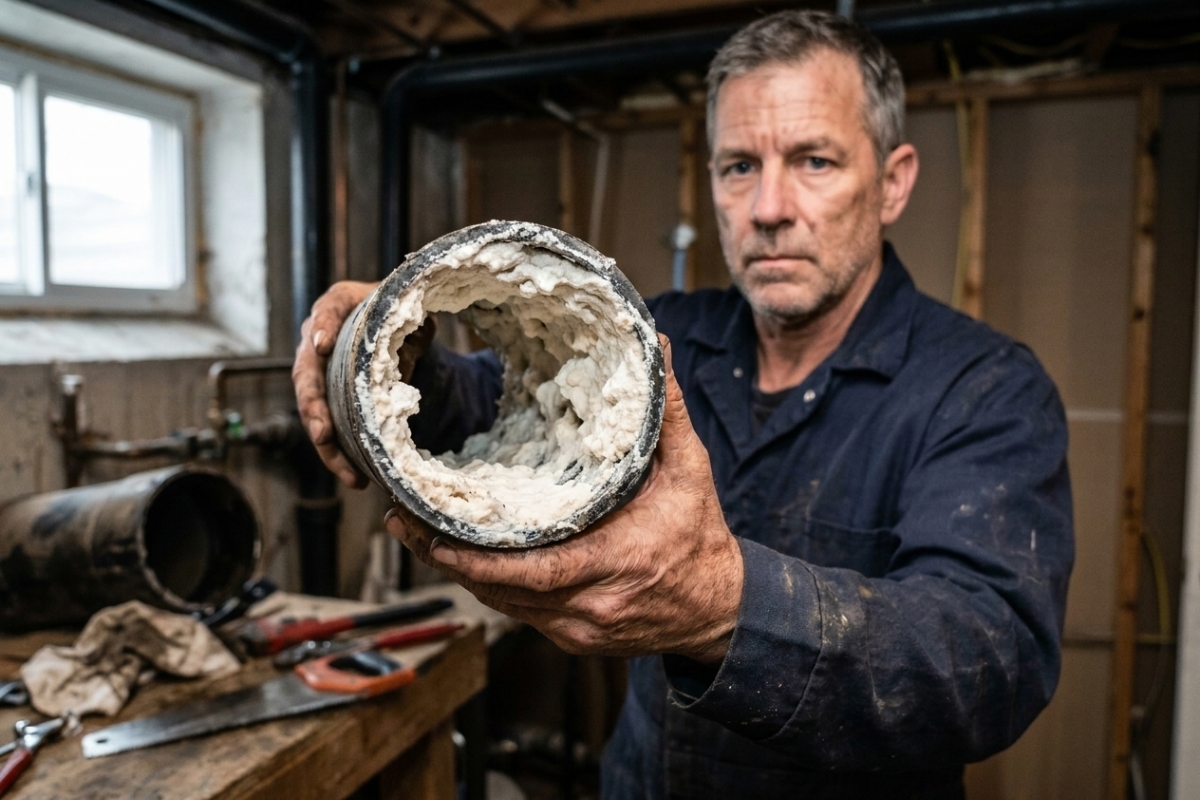
It was the smell that first tipped Martin Hughes off. Sweet, musty, faintly faecal — even though the bathroom in the craftsman home in Atlanta’s Decatur neighborhood looked spotless. The tiles gleamed, the toilet had just been bleached, a fresh rim block was stuck under the bowl.
Hughes pulls on his gloves and saws out a section of the drain pipe. Now it lies on the worktop: about 8 inches of pipe, the inside coated with an inch-thick, black-brown layer. Slick. Living. Like wet tar.
“This,” says Hughes, holding it up to the camera, “came from a perfectly ordinary family toilet. Four people. Three-bedroom home. And this is exactly what it looks like in most British homes — the residents just never see it.”
Martin Hughes is a master plumber in Atlanta, third-generation family business. 28 years of experience. Over 15,000 toilets repaired, uncovered, taken apart. And he says: “What people think of as clean and what’s actually happening inside their pipes — those are two completely different worlds.”
The nasty truth your plumber never tells you
Everyone uses their toilet daily. Most people clean it regularly — brush, bleach, maybe a rim block under the rim. And then they think: job done.
But what happens behind the porcelain, where nobody looks? Inside the drain pipes that lead from your toilet down to the sewer?
Hughes describes it like this: “Think of plaque on your teeth. You can run your tongue across them ten times a day — the plaque stays put. Only a proper clean gets it off. That’s exactly what happens in your pipes. Except you can’t see it — and nobody ever gets at it with a brush.”
Biologists call it biofilm. A living layer of bacteria, fungi, limescale, grease and organic residue. It starts forming from day one and grows continuously. Every flush pushes water through — but the biofilm clings to the pipe wall like a ring that slowly closes inward. Scientists sometimes call it “Biofilm Armour” because it is almost impossible to remove with conventional methods.
And here’s the problem: Everything you scrub on the porcelain has zero effect on the biofilm inside the pipes. The surface gleams — the pipes behind it are rotting.

“I always tell my customers: you’re brushing your teeth but never cleaning your throat. The toilet looks spotless, but the pipes are a disaster.”
— Martin Hughes, Master Plumber, Atlanta
The 4 stages of a pipe blockage — and why stages 1 and 2 are invisible
In 28 years, Hughes has recognized a pattern. Every blockage follows the same progression — and it doesn’t start when the water stops draining.


Why conventional cleaners don’t solve the problem — and often make it worse
Hughes has seen it all over the years. And he says: none of the common products solve the actual problem.

Lysol, Clorox & Co.: They clean the porcelain. The liquid flows straight through the pipe without any meaningful contact with the pipe wall. It’s like pouring water through a blocked pipe and hoping the buildup dissolves on its own.
Chemical drain cleaners (Drano, Liquid-Plumr): Aggressive acids that attack the top layer of the biofilm — but also the pipe itself. Old pipes become porous and brittle. Hughes: “I’ve removed pipes that were completely eaten away by chemical drain cleaners. The blockage was gone, but so was the pipe.”
Plunger: Pushes the blockage a bit further down. The biofilm remains completely untouched. The blockage is guaranteed to return.
Drain snake: Bores a hole through the blockage. Water flows again — through a hole in the biofilm. The pipe walls remain completely filthy. Two months later, same situation.
Emergency plumber ($200–400): Usually uses the same snake or high-pressure jetting. The pipe looks better for a few weeks — then the biofilm grows back, because the root cause was never addressed.
The discovery that made Steve Hughes skeptical — then convinced him
In spring 2024, Martin Hughes meets a colleague from Rotterdam at the KBIS trade show in Las Vegas. The man tells him about a cleaning powder that has been making the rounds in the sanitary industry across the Netherlands for several years. A powder you put into the toilet that foams up and dissolves the biofilm inside the pipes from within.
Hughes is skeptical. In 28 years, he has seen too many products that promised everything and delivered nothing.
But the colleague shows him a video: a pipe, completely black inside. Powder in, water added, foam rises. 30 minutes later: the pipe looks like new.
“I watched that video three times,” says Hughes. “Then I ordered a packet straight away.”
The product is called FizzClean.
Why FizzClean works where everything else fails — inside your pipes
The fundamental problem with all liquid cleaners is physics. Liquid flows downward. It follows gravity, runs along the lowest point of the pipe and has barely any contact with the side walls or the top of the pipe. But the biofilm sits everywhere — 360 degrees all around.
FizzClean uses a different principle: foam.
The powder is added to the toilet and activated with warm water. Within seconds, a dense, stable micro-foam forms that spreads through the pipe — not downward, but in every direction. The foam presses against the pipe walls, fills every cavity and completely encases the biofilm.
Then the patented micro-foam technology gets to work:
Step 1: The foam completely surrounds the biofilm and penetrates its structure.
Step 2: Natural enzymes in the foam break down the organic components of the biofilm — grease, limescale, bacteria colonies, organic residue.
Step 3: A normal flush carries away the dissolved biofilm. The pipe walls are clean — like the very first day.

“The first time I put FizzClean into an old pipe, I could literally watch the foam lift the grime off the wall. After 30 minutes the pipe was grey instead of black inside. After the second application, it was clean.”
— Steve Hughes
What most people don’t know: Your pipes are a breeding ground for dangerous bacteria
It’s not just about blockages. What many people don’t know: the toilet is one of the biggest hygiene hazards in the home — and not because of the porcelain.
Scientists at the University of Colorado have proven that every toilet flush creates a so-called “Toilet Plume”. Microscopic water droplets are propelled up to 6 feet into the air. These droplets contain bacteria, viruses and fungal spores — and they come not only from the bowl, but also from the biofilm inside the pipes.
The particles land on your towel. On your toothbrush. On the floor. On every surface in the bathroom.
As long as the biofilm exists inside the pipes, every flush is a bacteria shower for your bathroom. FizzClean eliminates the source — not the symptoms.

What users are saying after the first application
“Our toilet had been draining at a snail’s pace for at least six months. The gurgling at night drove me up the wall. I’d already got a quote from the plumber: $275 for a proper clean-out. Then I tried FizzClean — honestly as a last resort. Powder in, foam up, wait 30 minutes, flush. The water shot through like it was brand new. $275 saved, all for $29. Still can’t believe it.”
“I’m 74 and live alone. Twice a year the plumber had to come — $195 each time. My grandson gave me FizzClean for Christmas. I thought, what on earth is this. But I tried it. That was eight months ago. Since then: no plumber, no problem, no cost. My grandson is getting an extra-large portion of Sunday roast this year.”
“I’ve tried everything. Drano, plunger, even the drain snake from Home Depot. Nothing worked long-term. With FizzClean I was skeptical — another miracle product. But then I saw the foam rise up, how it works. You can literally see the grime dissolving. And the best part: the problem doesn’t come back. Four months and counting, everything clear.”
“We’ve got a 2-year-old daughter who’s just discovered the bathroom. Everything gets touched, licked, explored. When I read what gets flung around the room with every flush, I felt sick. Since then I use FizzClean every two weeks. No harsh chemical stink, no glove drama, just tip it in and done. Best hygiene upgrade for a family bathroom, hands down.”
“It was a Saturday night, 10 PM, we had guests round with drinks in hand and the toilet packed up. Emergency plumber: $350. For 20 minutes of work. On the Monday my son ordered FizzClean and said: Mom, tip this in once a month and you’ll never have this again. Seven months on — not a single problem. That $350 was my most expensive and my last emergency call.”

FizzClean works anywhere pipes can block
What started as a toilet cleaner works anywhere pipes get blocked and biofilm grows:
Toilet: Biofilm, blockages, odors — the primary use.
Basin: Hair, soap residue, toothpaste buildup in the pipes.
Shower/bath: Hair, shampoo residue, limescale deposits in the drain.
Kitchen sink: Grease, food scraps, oil deposits in the drain.
Washing machine: Lint, detergent residue in the drain hose.
One product for every drain in the house. Instead of five different specialist cleaners that all only work on the surface.
Where is the original available? (Beware of fakes)
FizzClean is available exclusively through the manufacturer’s official webshop. Not on Amazon. Not on eBay. Not at CVS or Walgreens.
Hughes warns explicitly: “On Amazon and eBay, counterfeits are now appearing that look similar but have completely different ingredients. They foam up, but do nothing to the biofilm. In the worst case, they damage the pipes.”
Why not on the high street? Because retailers like CVS and Walgreens would have to double the price as middlemen. Through direct-from-factory sales, the manufacturer can offer the best price — including fresh production, buyer protection and a money-back guarantee.
CURRENTLY: Up to 70% Discount — only while stocks last
As part of the Spring Promotion, the manufacturer is currently offering FizzClean at up to 70% off. Warehouse capacity is limited — once the current batch sells out, restocking typically takes four to six weeks.
Check now whether FizzClean is still available for your area:
